AI Startup Pitch Deck: Structure, Slides, and What Investors Actually Fund in 2026

In Q1 2026, an AI foundational model startup raised its Series A at a median valuation of $300 million. A non-AI startup at the same stage raised at $55 million, according to Carta. Same round. Same paperwork. A more than five-times gap. We covered why in our guide to startup valuation.
That gap is not free money. It is the market pricing in scarcity, defensibility, and a belief that a small number of AI companies will define the next decade of software. Which means the bar for what an AI pitch deck has to prove is proportionally higher.
Most AI founders walk into a raise with a deck that reads like a SaaS pitch deck with the word "AI" added to the headers. Investors, the ones actually writing these checks, read those decks in under four minutes and pass. Not because the technology is weak. Because the deck fails to address the three questions every AI investor asks before anything else: what is your moat, what happens when foundation models improve, and are your gross margins survivable at scale.
This guide covers what an AI investor evaluates, how the deck structure changes across AI sub-verticals, and the five slides where AI founders most often lose credibility.
IN THIS GUIDE
Why AI pitch decks are evaluated differently
The four AI sub-verticals and how the deck shifts across each
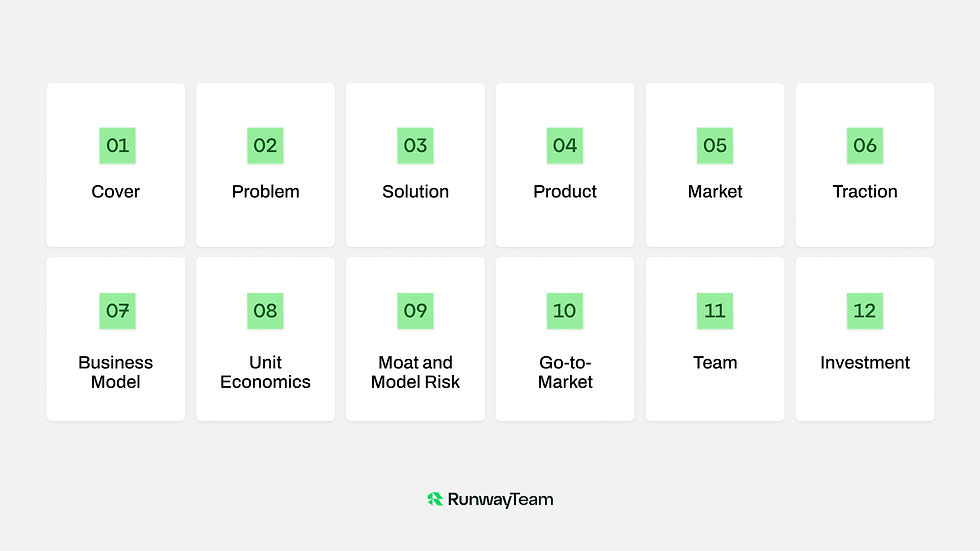
The 12-slide structure investors expect
The three questions every AI deck must answer
Gross margin, retention, and moat benchmarks for 2026
The five mistakes that quietly kill AI rounds
Why an AI Pitch Deck Is Different
A generalist SaaS deck is evaluated on team, market, traction, and business model. AI investors keep all four, then add three questions no other vertical adds in the same weight.
Moat replaces market as the first question
In SaaS, investors start with market size. In AI, they start with defensibility. The reason is structural: any function that can be delivered by a prompt against a general-purpose foundation model is, by definition, one API call away from being commoditized. Investors want to see whether your business has a moat that survives when GPT-6 and Claude 5 ship.
The four moats that count in AI right now: proprietary data (that you own and competitors cannot buy), workflow embedment (the customer's operations run on you), model performance (a real edge on a benchmark that matters), and distribution (you own the wedge into a market others cannot enter cheaply).
Gross margin becomes a slide, not a footnote
A SaaS company defends 75 to 80% gross margin without discussion. An AI application company operates at 40 to 60% and has to explain it. Compute costs are a real, ongoing line item that investors now model separately. Founders who ignore this on the deck signal they have not modeled their own unit economics honestly.
Model risk becomes an investor-side question
Every AI deck triggers the same investor thought: what happens if OpenAI or Anthropic ships this feature natively? Founders who pretend this risk does not exist lose the room. Founders who acknowledge it and explain their answer, whether that answer is proprietary data, workflow lock-in, or vertical depth, earn credibility.
An AI pitch deck is not scored on vision. It is scored on whether the founder understands the specific dimensions of defensibility, unit economics, and platform risk that separate an AI business from a wrapper.
The Four AI Sub-Verticals and How the Deck Shifts
Just as a fintech deck differs across payments, lending, and neobanks, an AI deck differs across four sub-verticals. Investors specialize. A deck that reads correctly to a foundational model investor reads wrong to a vertical AI investor.
1. Foundational models
Anthropic, Mistral, xAI-style companies. Capital-intensive, talent-dependent, benchmark-driven. The deck emphasizes model performance, compute strategy, safety posture, and talent density. Traction is measured in developer adoption, not revenue. Series A valuations are in the $200M to $500M range, and the audience is a small number of specialist funds. Only pursue this deck if you can credibly compete for AI research talent and secure sustained access to compute.
2. AI infrastructure and tooling
Vector databases, orchestration frameworks, evaluation platforms, MLOps tooling. The audience is builders. Engineers deciding what to adopt. The deck emphasizes developer traction (GitHub stars, active integrations, self-serve conversion), the standards story (why your primitive becomes the default), and the enterprise upsell path. Revenue often lags adoption, and investors expect that.
3. AI applications and vertical AI
The largest category, and where most AI founders sit. This includes horizontal applications (Harvey for legal, Cursor for coding) and vertical AI (specialized systems for healthcare, manufacturing, insurance). The deck must aggressively address the wrapper question. What is the workflow you own? What data compounds? What breaks if a customer switches to a general-purpose model? Revenue traction matters here, and investors expect real ARR by Series A.
4. AI agents
Autonomous systems executing multi-step tasks. Sales agents, coding agents, research agents. This category is the newest and least defined. Investors are underwriting a bet on autonomy timelines, not proven unit economics. The deck must show accuracy benchmarks on real tasks, failure mode analysis, and a credible path to reducing human oversight over time. Pilot metrics matter more than ARR at this stage.
The single most damaging mistake in AI fundraising is targeting the wrong investor. Payments funds do not evaluate lending. Foundational model funds do not evaluate vertical AI. Identify your sub-vertical first, then match the deck and the investor list to it.
The AI Pitch Deck Structure: Slide by Slide
An AI pitch deck runs 12 to 14 slides. The core structure mirrors any early-stage deck. What changes is the content of five specific slides: moat, model risk, unit economics, traction, and the ask. Every other slide keeps its shape but gets AI-specific evidence.
Slide 1. Cover
Company name, one-line positioning, stage, ask. The one-line positioning is where AI founders start losing investors. "AI-powered [category]" is not positioning. It is a category. State the specific workflow you own and the specific customer you serve.
Slide 2. Problem
A strong problem slide reframes the pain point in a way that only your solution answers. In AI, the problem slide has one extra job: it must anchor the reader in a workflow that a general-purpose chatbot cannot solve. If ChatGPT solves your problem in three prompts, your problem is not the problem you think it is.
Slide 3. Solution
What you built and how it works. For AI, this slide must communicate the system, not the interface. Show the data flow, the model layer, the orchestration, and where the moat sits. A screenshot of a chat window is not a solution slide. This slide should also carry your value proposition clearly: what changes for the customer, in their language, not yours.
Slide 4. Product
How the product is used, by whom, and in what workflow. For horizontal AI applications, show adoption breadth (roles, teams, use cases). For vertical AI, show integration depth (systems of record touched, workflow steps automated, human oversight required).
Slide 5. Market
A market size slide investors trust uses bottom-up sizing, not top-down. The category number ("$500B AI market by 2030") is dismissed on sight. What earns credibility is the target segment, the number of buyers, the current spend on the workflow you replace, and the wedge you enter through. If you need a framework for showing market opportunity credibly, use TAM, SAM, and SOM with real bottom-up math, not a Statista headline.
Slide 6. Traction
Revenue, growth, retention, and depth of use. For AI applications, the traction slide carries more weight than in most verticals because it is the primary evidence of pull. Retention and depth-of-use matter more than raw ARR at the seed stage. A product with 200 customers, 92% retention, and rising usage per seat is a stronger signal than one with 400 customers, 65% retention, and falling engagement. Where you have named customers or pilots, tie them into a clear market validation story: real buyers, real behavior, real willingness to pay.
Slide 7. Business model
Who pays, how, and for what unit of value. Your business model slide needs to acknowledge a specific 2026 dynamic: seat-based pricing is under pressure in AI because it does not scale with value delivered by autonomous systems. Usage-based, outcome-based, and hybrid models are increasingly the norm. Show your pricing logic and, if you have moved through a pricing change, show the ARR impact.
Slide 8. Unit economics
This is where most AI applications quietly bleed. LTV:CAC above 3:1 remains the standard, but AI adds a compute margin line that must be shown. Break out revenue per customer, gross margin (net of compute), CAC payback in months, and, for usage-based products, the trend of margin as usage scales. If your unit economics show 45% margin at current scale, show the path to 60%+ as inference costs decline or as you move to smaller fine-tuned models. This is also where a defensible financial model earns its place: the numbers on the slide have to reconcile with the numbers in the model, or investors will notice on the first diligence call.
Slide 9. Moat and model risk
This is the slide that does not exist in a generalist deck. In an AI deck, it is mandatory. Whether that means treating it as a dedicated slide or folding it into your competition slide, the content has to land.
One slide, two questions. What is your defensibility (data, workflow, model, distribution, pick the one that is real). What is your answer to platform risk (what changes for your business when GPT-6 ships).
Founders who address this slide directly earn credibility. Founders who skip it prompt the question anyway, and answer it under pressure, which never lands as well.
Slide 10. Go-to-market
How you acquire customers profitably. For horizontal AI applications, PLG (product-led growth) metrics matter: activation rate, time to first value, self-serve conversion. For vertical AI, enterprise sales metrics matter: ACV, sales cycle length, land-and-expand ratio. Your go-to-market slide should show the motion that fits your ACV, and it should show one working channel with real numbers before claiming any "multi-channel" strategy.
Slide 11. Team
For AI companies, domain plus AI credibility. "Former ML researcher plus former product leader in [target vertical]" beats a generic engineering team every time. Investors underwrite two things at the team slide: can you build the technology, and can you sell it into this specific market. If either half is missing, address the plan to close the gap.
Slide 12. The Ask
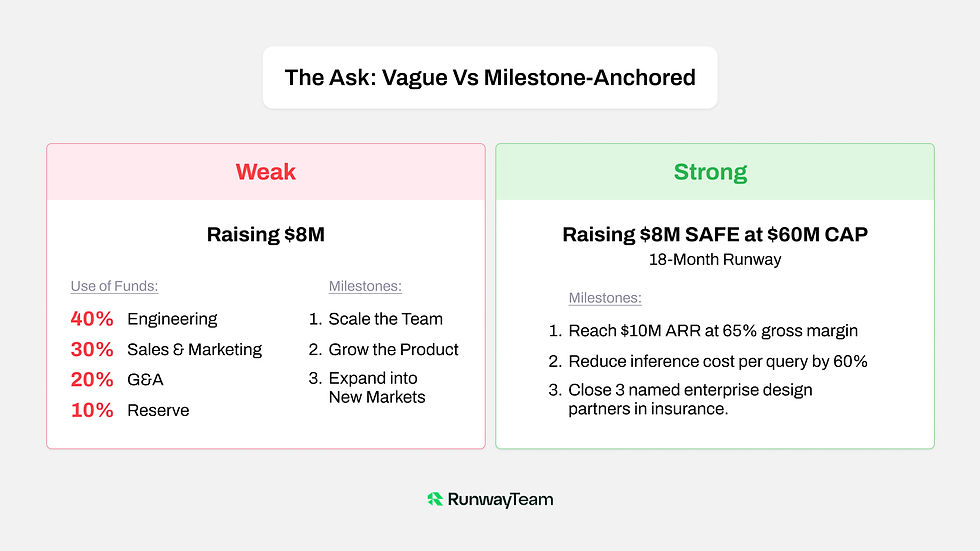
Amount, milestones, and a clear use of funds. In AI, milestones tied to model performance (accuracy on a specific benchmark, latency at a specific throughput) carry weight alongside standard growth milestones. "Raising $8M to reach $10M ARR with 65% gross margin and reduce inference cost per query by 60%" is a milestone-anchored ask. "Raising $8M for growth" is not.
The Three Questions Every AI Deck Must Answer
Every AI investor filters decks through the same three questions before anything else. If the deck does not answer them clearly, the meeting ends before the market or team slide is discussed.
Question 1. What is your moat?
Not "we are the AI leader in [category]." That is not a moat, it is a claim. A moat is a structural reason a competitor cannot copy you in six months with the same base models.
The four moats that survive scrutiny in 2026:
Proprietary data. You own or have exclusive access to training or inference data competitors cannot buy.
Workflow embedment. Customers run their operations on you, and switching costs are measured in weeks of retraining, not minutes.
Model performance. You have a defensible edge on a benchmark customers care about, and the edge compounds with data.
Distribution. You own a wedge (a category-defining customer, a regulator, a channel) that competitors cannot enter cheaply.
Pick one. Two if you have them. Do not claim all four.
Question 2. What happens when foundation models improve?
Investors know that GPT-6, Claude 5, and Gemini 3 are shipping. They want to know whether that helps you or destroys you.
A strong answer names the specific capability improvement, explains why it strengthens your product (better base model to better output for your users at lower cost), and shows how your moat holds regardless. A weak answer either ignores the question or promises "we will keep innovating."
Question 3. Are your gross margins survivable at scale?
Show the current margin. Show the path. Show the assumptions.
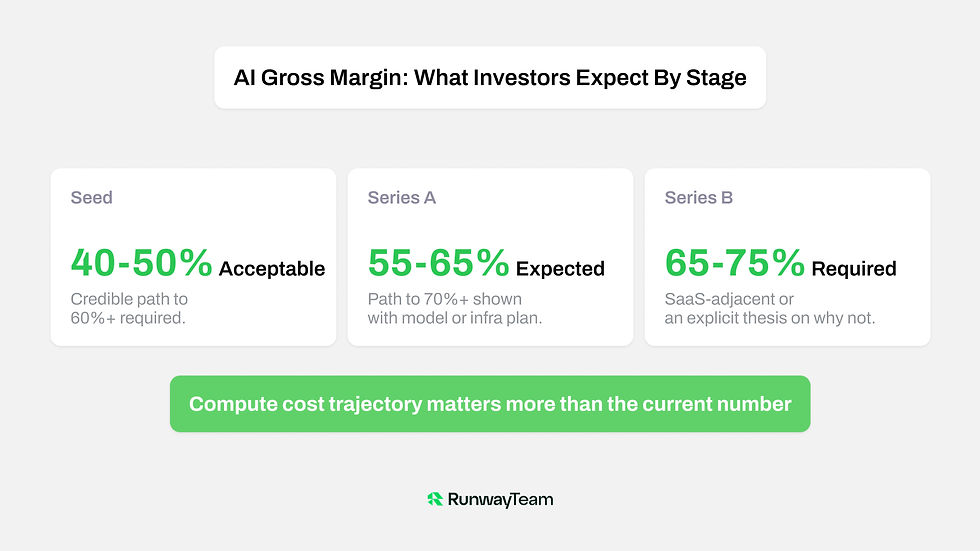
At the seed stage, a 40 to 50% gross margin with a credible path to 60%+ is acceptable. At Series A, investors expect the path to be started, not started later. At Series B, gross margin should approach SaaS benchmarks (65 to 75%) or the company needs to explain why the AI-native cost structure has different economics that investors will accept.
Five Mistakes That Kill AI Pitch Decks
Mistake 1. Wrapper positioning
The deck describes a product built entirely on top of GPT or Claude with no proprietary layer. Investors read this as a feature, not a company. If your only moat is prompt engineering, the deck will not close a round in 2026.
Mistake 2. Overreliance on model benchmarks
For foundational model and infrastructure companies, benchmarks matter. For everyone else, they are a distraction. Nobody buys a legal AI product because it scored 3% higher on MMLU. They buy it because it saves associates 12 hours a week. Show the customer outcome, not the benchmark.
Mistake 3. Hiding compute costs
Founders show revenue and skip gross margin, or show gross margin but exclude inference costs. Investors ask about compute anyway. The founders who addressed it proactively already earned trust. The founders who dodged it lose it.
Mistake 4. Claiming autonomy the product does not deliver
Pitch: "our AI agent handles the entire workflow autonomously." Product demo: a human reviews every output. Investors do this diligence in the first customer call. If the deck overpromises and the reality is human-in-the-loop, the round is over.
Mistake 5. Ignoring platform risk
The deck says nothing about what happens when foundation models improve. The investor asks. The founder answers on the fly. The answer is defensive. This is the most common failure mode in the room, and it is entirely preventable by addressing it on Slide 9.
How the AI Deck Changes by Stage
The slide structure holds across stages. The evidence expected on each slide changes. For the deeper stage-by-stage playbooks, see our guides to raising a seed round, the Series A pitch deck, and the Series B pitch deck.
Stage | What investors weigh most | Metrics they expect |
Pre-seed | Team, technical insight, wedge | Prototype, early user signal, no revenue required |
Seed | Product-market fit signal, retention | $200K to $1M ARR, 90%+ logo retention, rising usage per customer |
Series A | Repeatable GTM, margin trajectory, moat | $1M to $5M ARR, 45 to 55% gross margin, one working channel |
Series B | Scale efficiency, defensibility proven | $8M to $25M ARR, 60%+ gross margin, cohort retention data |
The gap founders most often misread is between seed and Series A. At seed, investors will fund the wedge and the team. At Series A, they will not. The Series A deck must prove the wedge is repeatable, the margin path is real, and the moat has evidence behind it, not just a claim. If you are building an AI-native SaaS product specifically, the B2B SaaS pitch deck guide covers the ICP, ACV, and metrics layer that overlap with an AI application deck.
When AI Founders Should Get Help With the Deck
A few signals that the deck is holding back the round:
Investors keep asking the same three questions (moat, margin, model risk) after every meeting.
The product is strong, but the second meeting rate is low.
Investors describe the company as "interesting but hard to categorize."
The team is technical, and the narrative has never been pressure-tested by someone who has watched a real fundraise close.
At RunwayTeam, we work with AI founders across foundational models, infrastructure, applications, and agents. Our fundraising consulting work starts with the moat and unit economic story, because that is where AI decks either earn the room or lose it, and moves through the deck, financial model, and outreach in parallel. If your deck is not moving investors from first meeting to second, book a strategy call and we will tell you where it is losing them.
Frequently Asked Questions
What is an AI startup pitch deck?
An AI startup pitch deck is the fundraising document AI founders use to raise capital from venture capital firms and angel investors. It is a 12 to 14 slide narrative that explains the problem, product, moat, unit economics, traction, and the raise. What makes it distinct from a standard startup deck is the added burden of proving defensibility, addressing platform risk from foundation model providers, and defending gross margins that include compute costs.
How is an AI pitch deck different from a SaaS pitch deck?
A SaaS pitch deck focuses on ARR, retention, and unit economics with 75%+ gross margin as the default assumption. An AI pitch deck adds three requirements: a dedicated moat slide, explicit compute cost accounting in unit economics, and an answer to the question of what happens when foundation models improve. AI decks are also scrutinized more heavily on wrapper risk, whether the product is genuinely defensible or one API away from being obsolete.
How many slides should an AI pitch deck have?
Twelve to fourteen slides. Fewer than twelve leaves gaps investors will ask about. More than fourteen loses the reader. The five AI-critical slides (traction, business model, unit economics, moat and model risk, and the ask) should each carry their own weight. Do not compress them.
What do AI investors care about most?
Three things, in order: moat, unit economics, and team. Moat because AI without defensibility is a feature. Unit economics because compute costs are a real, ongoing drag that founders often underestimate. Team because AI companies live and die on the ability to attract and retain research and engineering talent that is being competed for aggressively.
Do I need to show model performance benchmarks in my deck?
Only if you are a foundational model company or an infrastructure company where benchmarks are the primary buyer signal. For AI application companies, benchmarks are a distraction. Show the customer outcome (hours saved, revenue generated, error rate reduced), not the benchmark. A benchmark score does not translate to willingness to pay, and investors know that.
How should I address the "what if OpenAI ships this?" question in my deck?
Address it directly, on the moat and model risk slide. Name the specific capability improvement you expect, explain why it strengthens your business rather than destroys it, and show what part of your moat is independent of the base model. Founders who dodge this question in the deck are asked it in the meeting and answer under pressure, which never lands as well as a pre-considered answer.
What gross margin do AI investors expect at each stage?
At seed, 40 to 50% is acceptable if the founder shows a credible path to 60%+ through smaller fine-tuned models, better routing, or infrastructure improvements. At Series A, 55 to 65% is expected with the path started. At Series B, 65 to 75% is required or the company needs a specific thesis on why AI-native economics are structurally different and why investors should accept that.
Should my AI pitch deck include a demo video?
A short embedded demo is optional and useful when the product is difficult to explain in static screenshots. Keep it under 60 seconds. Do not rely on it to carry the deck. The slides must stand alone because most investors will read the deck without playing the video.
Ready to build an AI pitch deck that closes rounds?
AI fundraising is harder than SaaS fundraising in one specific way: the deck has more to prove, and investors have less patience for the parts that are not proven. Moat, margin, and model risk are not optional slides in 2026. They are the three questions the deck lives or dies on.
At RunwayTeam, we have helped AI founders across foundational models, infrastructure, applications, and agents build pitch decks and financial models grounded in real investor decision-making. If you are raising for an AI startup and want a deck that holds up in the room, book a strategy call with our team.