What Investors Look for on Your Team Slide (With Examples)


Investors spend more time on your team slide than almost any other part of your pitch deck.
According to DocSend data, it accounts for about 15% of total viewing time, second only to financials.
That’s not accidental.
Before they believe your market, your product, or your projections, investors ask one question:
Why this team?
In simple terms, the team slide is where investors decide whether your startup is worth believing in.
This guide breaks down:
What investors actually evaluate
What to include and what to cut
How to write bios that signal real credibility
Real examples that worked
And how to handle edge cases like solo founders
If you have already defined your problem, this is where you prove you are the right team to solve it.
What Is the Team Slide and Why Investors Read It First
The team slide is a single slide in a pitch deck that shows who is building the company and why they are qualified to do it.
It is not an introduction. It is a decision filter.
Investors scan this slide to answer:
Why should this team win instead of the 10 others pitching this same idea this month?
At early stages, execution risk is the biggest risk.
That means your team is the product.
A strong team slide:
Reduces execution risk
Signals speed and competence
Makes the rest of the deck believable
A weak one does the opposite.
What Investors Actually Evaluate on Your Team Slide
Investors evaluate your team across four signals.
1. Founder-Market Fit
Founder-market fit means your background clearly connects to the problem you are solving.
Signals include:
Industry experience
First-hand exposure
Insider knowledge
This connects directly to how you position your market.
2. Execution Track Record
Execution track record shows whether you have built, sold, or delivered results in the past.
Investors look for:
Revenue growth
Products launched
Teams managed
This is what makes your financial story credible.
3. Team Completeness
Team completeness means the core functions of the business are covered.
Investors check:
Product or engineering
Sales or go-to-market
Hiring ability
If one is missing, risk increases.
4. Coachability Signals
Coachability means presenting your experience clearly, without exaggeration.
Strong signals:
Specific outcomes
Clear roles
Acknowledged gaps
Weak signals:
Buzzwords
Vague claims
Overstated impact
What to Include on the Team Slide and What to Cut
What to include
A strong team slide includes:
Name and role
One-line credibility statement tied to the startup
Relevant company logos
One measurable achievement
A team slide should include the founder’s name, role, a brief credibility statement, relevant past companies, and one measurable achievement demonstrating execution ability.
What to cut
Remove anything that does not help an investor assess execution:
Degrees unless directly relevant
Generic titles
Org charts
Irrelevant roles
This is not a resume. It is a signal.
If you are a solo founder
A solo founder team slide should show depth, support, and a plan.
Include:
Your strongest relevant experience
2 to 3 active advisors
Planned hires tied to funding
This reframes risk into a roadmap.
How to Write Team Bios That Signal Credibility
Strong bios are specific, measurable, and easy to scan.
The rule:
No adjectives. Only facts.

Example 1: Commercial Co-Founder
Weak
Experienced sales leader
Better
VP Sales at Intercom
Best
Led 12-person sales team at Intercom, grew ARR from $2M to $18M in 3 years
Example 2: Technical Co-Founder
Weak
Experienced engineer
Better
ML Engineer at Google
Best
Built systems serving 50M+ users, improved engagement by 27%
Key takeaway
A strong bio answers three questions instantly:
What did you do
Where did you do it
What changed because of you
If an investor cannot understand your impact in 5 seconds, rewrite it.
Team Slide Layout Breakdown
A team slide should be simple, structured, and fast to scan.

Key rules
Show 2 to 4 core people
Keep bios to 1-2 lines
Use logos instead of long descriptions
Separate advisors visually
Investor signal
Charles Hudson has noted that teams with more than three co-founders can raise concerns about decision-making.
Real Team Slide Examples That Worked With Investors
Example 1: RockED

RockED's slide leads with a full leadership bench - eight named executives covering every function from co-founders to VP of Content and VP of Partnerships. What signals credibility here isn't any single person, but the completeness of the team and the clear division of specialisms. Investors see no obvious gaps, and the "Leadership Vision" panel at the bottom anchors the team to a specific, verifiable market (automotive dealership training), which removes ambiguity about direction.
Why it worked:
Full coverage across sales, content, learning and partnerships - no obvious hiring gaps
Defined market context (automotive training) makes the team feel purpose-built, not generic
Mission statement panel converts a list of names into a coherent leadership story
Example 2: Vikk AI
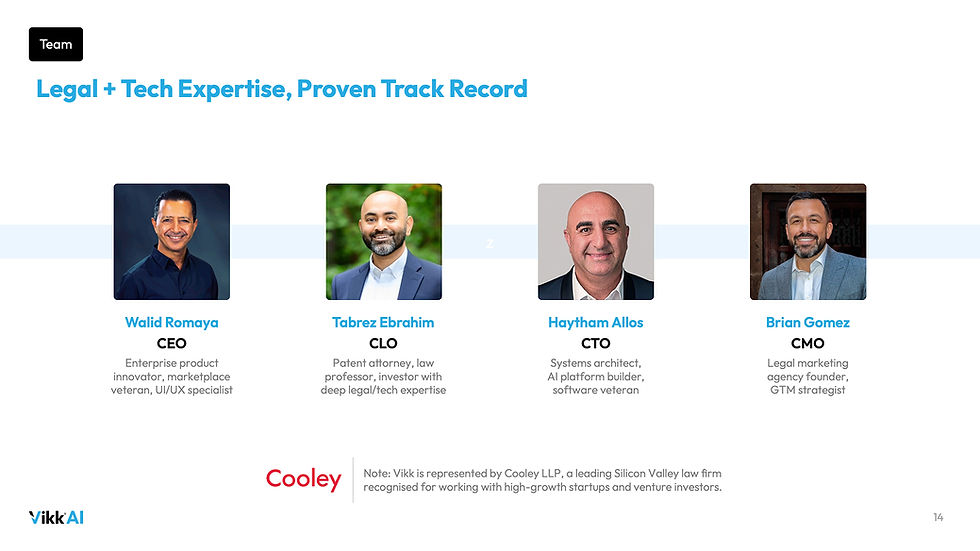
Vikk AI's slide is built around a deliberate theme: legal plus technical expertise. Every person maps directly to that claim - a CLO who is both a patent attorney and a law professor, a CTO with AI platform experience, a CEO with product and UX depth, and a CMO with legal-market-specific GTM experience. The Cooley LLP note at the bottom adds a layer of institutional validation that reinforces the team's credibility without requiring another slide.
Why it worked:
Each role directly proves the "legal + tech" headline - no filler bios
The CLO's dual credentials (attorney and professor) signal rare depth in a niche domain
Third-party validation (Cooley) adds investor-recognizable credibility without overclaiming
Example 3: Bookmypet

Bookmypet's slide combines a tight four-person core team with a logos strip of past employers (Mars, P&G, Henkel) and a named collaborators panel showing institutional backers. This structure lets a lean founding team look well-resourced. The bios are short but specific - years of experience, named companies, and concrete outputs - which signals domain depth rather than just functional coverage.
Why it worked:
Past employer logos (Mars, P&G) establish instant FMCG and petcare credibility
Collaborators panel signals traction and warm relationships with investors and brand partners
Tight bios with specific metrics ("15+ years," named exits) earn trust without padding
Common Mistakes on the Team Slide
A weak team slide usually fails in predictable ways:
Titles without outcomes
Showing the full org chart
Using education as the main signal
Placing the slide at the end
Ignoring missing roles
Each of these reduces clarity.
Conclusion
Your team slide answers one question:
Why are you the right team to solve this problem?
If that answer is clear, investors continue.
If it is not, they stop.
If you want your pitch deck to not only look clean but also work in investor conversations, RunwayTeam builds decks based on how funding decisions are made.
FAQ
What should be on a team slide in a pitch deck?
A team slide should include the team name, roles, a brief credibility statement, relevant company logos, and one measurable achievement. Limit the slide to 2-4 core team members, and include advisors only if they are active.
Where should the team slide go in a pitch deck?
The team slide is usually placed after the problem and solution slides. This allows investors to understand the context before evaluating the team.
How long should a team slide be?
A team slide should be one slide. If needed, it can be extended to two slides: one for founders and one for key hires.
What if I am a solo founder?
A solo founder should highlight relevant experience, include active advisors, and show planned hires tied to funding.
Do investors care about the team slide?
Yes. At early stages, the team is often the most important factor in investment decisions.
Should I include advisors?
Advisors should be included only if they are active and relevant. They should be placed separately from the core team.
What makes a bad team slide?
A bad team slide includes vague bios, no measurable achievements, irrelevant details, and unaddressed gaps.
How many people should be on the team slide?
A team slide should include 2 to 4 core members who directly contribute to execution.