Solution Slide in a Pitch Deck: Structure, Examples, and What Investors Look For


Founders spend the most time building their solution slide. Investors spend the least time reading it. That mismatch is why most solution slides fail.
The average investor spends under four minutes on a pitch deck on the first pass. Problem and solution together get roughly 30 seconds. In that window, one thing has to land: what you built, and why it works when other approaches have not. Anything beyond that is noise.
The strongest solution slides are the shortest. Three lines. One diagram. One sentence an investor can repeat to their partners on Monday morning. Founders who cannot compress their solution to that level usually do not yet understand it clearly enough to raise on it. That is not a design problem. It is a thinking problem, and this guide covers how to fix it.
Below, what a solution slide is (and what it is not), what investors evaluate in 15 seconds, the four elements a strong solution slide always contains, and the five mistakes that quietly kill decks.
IN THIS GUIDE
What a solution slide is (and how it differs from a product slide)
What investors evaluate in 15 seconds
The four elements every strong solution slide contains
Weak vs strong solution slide examples
The five mistakes that kill solution slides
How the slide changes by stage and by industry
What a Solution Slide Is (and What It Is Not)
The solution slide is the answer to the problem slide. It explains what you built, how it works at a mechanism level, and why that mechanism resolves the specific pain the problem slide raised. Investors read the two slides as a pair. If the solution does not logically follow from the problem, the deck loses trust in the first minute.
A solution slide is not a product slide. It is not a feature list. It is not a screenshot of your app. Those artifacts belong later in the deck, in the product section. The solution slide is upstream of all of them. It is the concept, not the interface.
A useful way to think about it: the problem slide names the pain, the solution slide names the mechanism, the product slide shows the artifact. Three distinct slides doing three distinct jobs. Founders who collapse them into one confuse the room.
A solution slide answers three questions in the reader's mind: what is it, how does it work, and why does it work when other approaches have not. Everything else on the slide is noise.
Why the Solution Slide Matters More Than Founders Think
There is a common assumption that later slides carry more weight. Traction, financials, team - those are the slides investors ask about in the meeting. So founders under-invest in the solution slide, assuming the numbers will do the work.
They will not. Investors decide whether to keep reading based on the first three to four slides. If the solution does not land, the traction slide never gets a real look. The numbers land in a vacuum. The rest of the deck is skimmed to confirm what the investor has already decided, which is usually no.
The solution slide also does something no other slide does: it makes the company sharable. When an investor forwards your deck to a partner, or brings you up in a Monday partner meeting, they need one sentence to describe what you do. That sentence comes from your solution slide. If the sentence is generic, memorable, or wrong, that is what the next check writer hears about you.
The economic weight of the slide is proportional to that: a solution slide that generates one memorable sentence is doing more for your round than most of the pages after it.
What Investors Evaluate on a Solution Slide
Investors reading a solution slide test four things, in order, in about 15 seconds.
1. Clarity of thinking
Can the founder describe what they built in one line, without buzzwords, in language a non-technical partner can repeat? Clarity of language on this slide is a proxy for clarity of thinking. Muddled solution language signals a founder who is still figuring out what they are building.
2. Fit to the problem
Does the solution mechanically resolve the problem the problem slide raised, or does it solve a different, adjacent problem? The most common mismatch is a founder who raised a Big Problem ("legal work is inefficient") and then presents a narrow solution ("contract review software for mid-market GCs"). The solution is fine. The problem framing was too big. Investors notice the gap immediately.
3. Mechanism, not features
Investors want to understand how the solution works, not what buttons it has. Mechanism means the underlying approach that produces the outcome. "We match verified freelance developers to companies within 48 hours using an automated skills-graph and human interviews" is mechanism. "AI-powered talent platform for engineering teams" is not.
4. Why now
A strong solution slide implies (or states) why this approach could not have worked five years ago and can work now. Something changed - technology, cost curve, regulation, behavior. Investors evaluate whether the timing thesis is real or manufactured.
The Solution Slide Structure: Four Elements That Land
The strongest solution slides across thousands of decks share the same four elements. Not five, not seven. Four.

Element 1. The one-line statement
One sentence, at the top of the slide, in the biggest type. It should describe what the product does in language a non-technical person can repeat. If the sentence contains a category ("AI-powered platform for X"), rewrite it. Investors have heard the category. They want to know what you specifically built.
Rule of thumb: if you cannot write the sentence without using the words "platform," "solution," or "powered," you do not yet have the sentence.
Element 2. The mechanism
A short visual or three-step flow explaining how the product actually produces the outcome. This is the piece founders most often skip. Investors want to see the how, not just the what. A three-arrow diagram beats three bulleted features every time.
For a marketplace, it is the matching mechanism. For SaaS, it is the workflow that changes. For hardware, it is the physical form and how it is used. For an AI product, it is the data flow and where intelligence lives in the pipeline.
Element 3. The differentiator
One sentence, immediately after the mechanism, that answers: why does this work when other approaches have not? The differentiator is not the same as the competition slide. That comes later. This is a preview, in one line, that gives investors permission to keep reading.
Element 4. The proof point
One number, one customer quote, or one named logo that shows the mechanism working in reality. This is where the solution slide connects to the traction slide that comes later. A single proof point at the bottom of the solution slide raises the credibility of everything that follows. It is often the difference between a deck that gets a second meeting and one that does not.
Four elements, one slide. If any of them requires a second slide to explain, the concept is not yet compressed enough for a fundraise. Compress first, then design.
Solution Slide Examples: Weak vs Strong
Two versions of the same concept, side by side. The company is the same, the technology is the same. The framing is different.
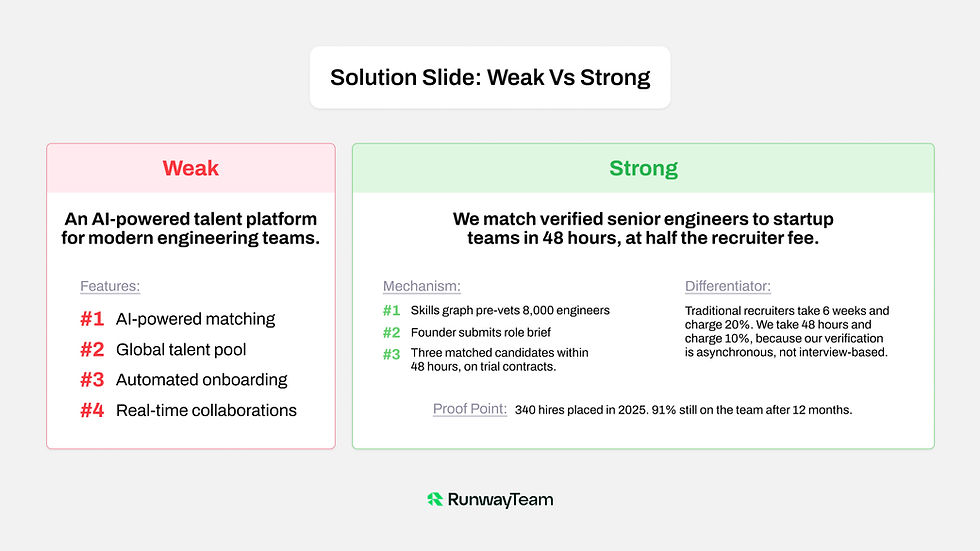
Both slides describe the same company. Both are technically true. Only one will get a second meeting.
The weak version leads with the category ("AI-powered talent platform") and lists six features. It could be describing four different companies. The strong version replaces the category with a specific mechanism (verified engineers, 48 hours, half the fee), explains how that mechanism works in three steps, contrasts it against the incumbent (recruiters at 6 weeks and 20%), and closes with proof (340 hires, 91% retention).
The strong version takes the same amount of space. It just uses that space to say something specific.
Five Mistakes That Kill Solution Slides
Mistake 1. Feature bloat
The slide lists eight to twelve product features. Investors read three of them and stop. Feature lists signal that the founder has not yet made a call on what the product primarily is. Pick the two or three principles that matter most and drop the rest. Everything else can go in the appendix or in a follow-up meeting.
Mistake 2. Category language instead of mechanism
"An AI-powered platform for X." "A next-generation solution for Y." "A modern approach to Z." These sentences describe a category, not a company. Every founder in the same category can write the same sentence. Investors have heard them all. Replace category language with a specific verb + object: what your product actually does, in a way a competitor could not say verbatim.
Mistake 3. Product screenshot as solution
A screenshot of your dashboard is not a solution slide. It shows the interface, not the mechanism. The interface belongs on the product slide, later in the deck. The solution slide should communicate the concept in a way that would still make sense even if you had not built a UI yet.
Mistake 4. Solution before problem
The slide describes what you built without anchoring to the pain the problem slide raised. If your solution slide can be understood without reading the problem slide first, the two slides are not connected. Rewrite the solution so it explicitly resolves the specific pain point named on the previous slide. Investors read them as a pair, and the second slide has to close the loop the first one opened.
Mistake 5. Missing the proof point
The slide describes what the product does but shows no evidence that it works. A single number, quote, or named customer at the bottom of the slide raises the credibility of everything above it. Founders often defer proof to the traction slide, but the traction slide is 15 seconds away. Do not make the investor wait when a single line can do the work now.
How the Solution Slide Changes by Stage and Industry
The slide structure holds across stages. What changes is what counts as a proof point and how much mechanism detail investors expect.
Stage | What the solution slide must show | What the proof point looks like |
Pre-seed | Clarity of thinking and mechanism logic | A prototype screenshot or 2-3 design partner logos |
Seed | Working mechanism with early usage | Number of active users, cohort behavior, or a customer quote |
Series A | Mechanism proven at commercial scale | Named enterprise customers or a headline ARR number |
Series B+ | Mechanism defensible at scale, moat implied | Retention data, market share, or category leadership signal |
Industry variations are more pronounced than stage variations. A few examples:
SaaS solutions lead with the workflow that changes. What used to take 4 steps now takes 1. What used to require 3 tools now requires yours.
AI startups lead with the data flow and where intelligence lives in the pipeline. The solution slide has to answer the moat question in one line.
Biotech companies lead with the mechanism of action. The literal biological or chemical pathway your therapeutic or platform intervenes in.
Healthcare companies lead with the clinical workflow that changes, then reference the outcome (readmission rate, time to diagnosis, cost per patient).
Marketplace companies lead with the matching mechanism. Who is on each side, how they find each other, what the transaction unit is.
Hardware companies lead with the form factor and the use case. A rendered image is often more useful than a diagram, but only if the image itself communicates the mechanism.
How the Solution Slide Connects to the Rest of the Deck
The solution slide sits between the problem and the product, and it feeds into almost every slide that follows. Investors expect the whole deck to reconcile back to what the solution slide claimed.
Upstream, it must resolve the problem the previous slide raised, and it should preview the value proposition you will unpack later.
Downstream, the solution slide sets up the business model slide (how you monetize the mechanism), the go-to-market slide (how you deliver the mechanism to buyers), and the competition slide (why your mechanism wins). It also implicitly sizes the market opportunity by defining what workflow or category you are entering.
Every proof point on the solution slide should reconcile with numbers on the traction slide and be independently verifiable through your market validation story. A solution slide that overpromises what the rest of the deck delivers costs credibility on every subsequent slide.
When Founders Should Get Help With the Solution Slide
A few signals that the solution slide is holding back the round:
Investors ask "so what does the product actually do?" after reading the slide.
Different investors describe the company to you in noticeably different ways after meetings.
The one-line statement takes more than one line to say.
You have redesigned the slide five times and it still feels dense.
These are usually not design problems. They are compression problems, and they are hard to fix from inside the company because the founder is too close to the product to see the framing gap. Our fundraising consulting work often starts here: taking a founder's solution slide, pressure-testing it against the Series A or Series B investor lens, and rebuilding it until the one-line statement lands cleanly in the first read.
Frequently Asked Questions
What is a solution slide in a pitch deck?
A solution slide is the slide that explains what you built, how it works at a mechanism level, and why that mechanism resolves the specific problem you raised on the previous slide. It sits between the problem slide and the product slide, and it is one of the first four slides investors read to decide whether to keep going.
What should a solution slide include?
Four elements: a one-line statement in the largest type on the slide, a short mechanism diagram or three-step flow showing how the product works, a one-sentence differentiator, and a single proof point (a number, quote, or named customer). Anything beyond those four elements is noise and should move to the product or traction slide.
How is a solution slide different from a product slide?
The solution slide is the concept. The product slide is the artifact. The solution slide describes what you built and how it works at a mechanism level. The product slide shows the interface, the user experience, and the features. The solution slide comes earlier in the deck and does not need any screenshots. The product slide comes later and is where screenshots and demo images belong.
Where does the solution slide go in a pitch deck?
Right after the problem slide, usually as slide 3 in a 12 to 14 slide deck. Investors read the problem and solution as a pair. Placing them next to each other is essential. Some founders put the market slide between them, which almost always weakens both slides. Keep problem and solution adjacent.
How long should the solution slide be?
One slide. If the solution requires two slides to explain, the concept is not yet compressed enough for a fundraise. Investors judge founders partly on their ability to compress complex ideas into a single frame. A two-slide solution signals a founder still working out what the product primarily is.
Should I use screenshots on the solution slide?
Usually no. Screenshots show the interface, not the mechanism, and they belong on the product slide. The exception is when the visual itself communicates the mechanism in a way words cannot (a hardware form factor, a marketplace matching interface, a diagram of a physical workflow). If the screenshot could be replaced with a diagram without losing information, use the diagram.
How do I make my solution slide memorable?
Make it repeatable. The one-line statement should be a sentence an investor can quote to their partner on Monday morning without having to reread the slide. Repeatable sentences are specific, concrete, and free of category language. "An AI-powered platform" is not repeatable. "We match verified engineers to startups in 48 hours" is.
What is the biggest mistake founders make on the solution slide?
Describing a category instead of a company. Founders default to category language ("AI-powered platform," "next-generation solution," "modern approach") because it feels safe and industry-standard. Every founder in the same category writes the same sentence. Investors have heard them all. The fix is to describe the specific mechanism your product uses, in language a competitor could not say word-for-word.
Ready To Sharpen The Slide That Decides Whether Investors Keep Reading?
The solution slide is doing more work than most founders realize. It generates the one-line description investors carry into partner meetings, it sets the credibility floor for every slide that follows, and it is often the reason a strong company gets read past the first minute of a first-pass review.
At RunwayTeam, we have built solution slides for over 700 startups across SaaS, AI, healthcare, biotech, fintech, and consumer categories. If your solution slide is not landing cleanly in the first read, book a strategy call and we will help you find the sentence that unlocks the rest of the pitch deck.